Visual Stream Thinking: Teaching AI to Watch, Understand, and Think in Real Time
Introduction
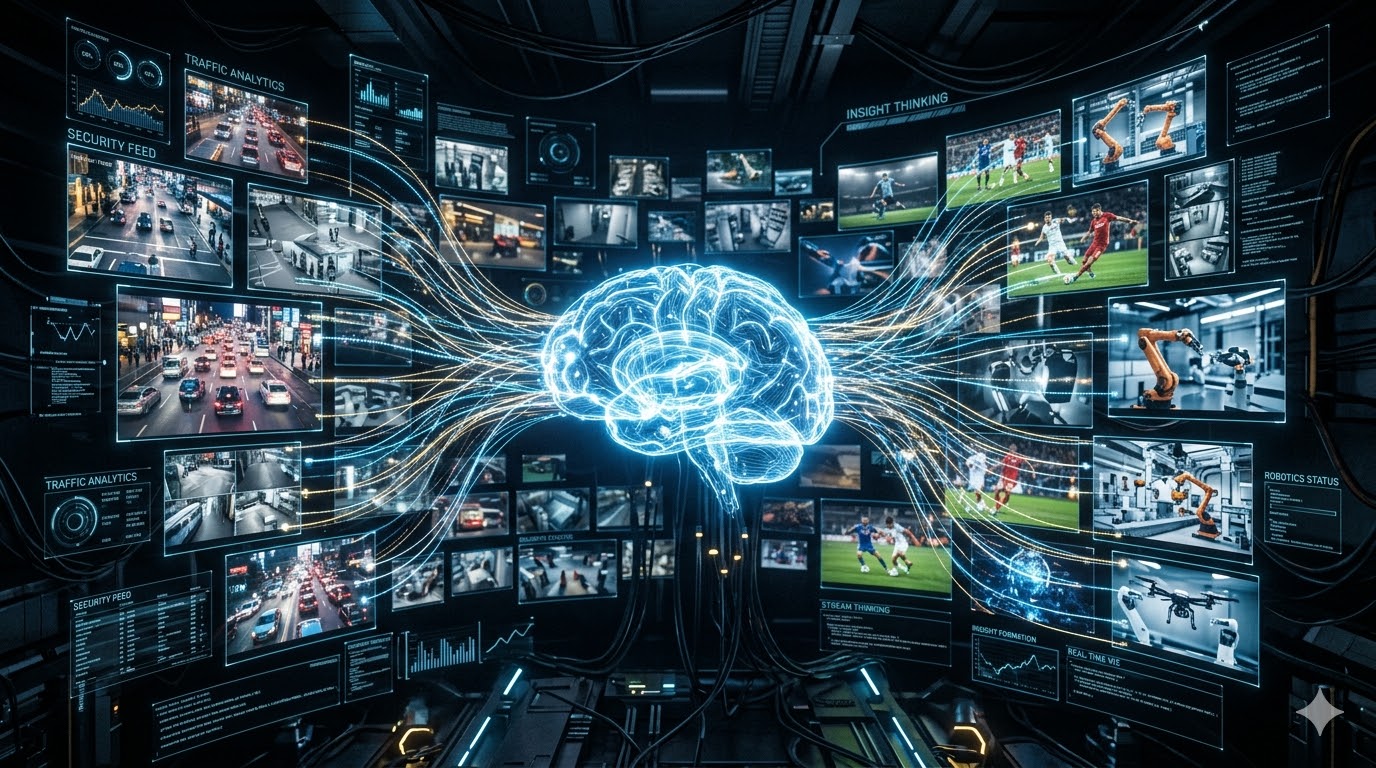
Artificial Intelligence has become very good at looking at images and identifying objects. A typical computer vision system can detect things like cars, people, or animals inside a frame. But the real world is rarely static. Most information today comes from continuous video streams — surveillance cameras, sports broadcasts, lectures, traffic monitoring systems, and even robots moving through physical environments.
To deal with this type of data, researchers are exploring a new approach called Visual Stream Thinking (VST). Instead of simply recognizing objects frame by frame, VST models try to understand what is happening in a scene over time. In simple terms, the goal is to move AI from just “seeing” to actually interpreting ongoing events.
What is Visual Stream Thinking?
Visual Stream Thinking is an approach in AI where models are designed to watch video streams and reason about them continuously in real time.
Traditional computer vision systems usually focus on tasks like:
- Object detection
- Image classification
- Face recognition
These tasks work well for static images, but they struggle with long video streams where context and sequence of events matter.
VST models try to solve this by allowing AI to:
- Continuously observe a video stream
- Maintain context over time
- Generate internal reasoning about what is happening
Instead of treating each frame separately, the system understands the story unfolding in the video.
Why Current AI Systems Struggle with Video
Many modern AI systems rely on Vision-Language Models (VLMs). These models convert visual data into text tokens so that language models can reason about them.
While this approach works, it introduces two major problems:
1. Latency
Converting visual information into text takes time, which makes the system slower when responding to queries.
2. Information Loss
Visual scenes contain complex spatial relationships and motion details that can be lost when translated into text.
VST models try to avoid this by reasoning directly inside a latent visual space, where the AI processes visual information without translating everything into language first.
Some emerging models, such as MONET, explore this direction by focusing on efficient visual reasoning instead of text-based reasoning pipelines.
The “Thinking While Watching” Approach
One of the most important ideas in VST is something called streaming reasoning — or simply thinking while watching.
Most traditional video AI systems behave like this:
- The AI watches a video.
- It stores the footage.
- It waits until a user asks a question.
- Only then does it start reasoning about the video.
This creates delays and makes the system feel slow in interactive situations.
VST systems change this workflow by thinking during the video itself.
While the video is playing, the AI continuously:
- Observes new frames
- Updates its internal understanding
- Generates reasoning steps about events
So when a question is asked later, the system already has context prepared.
The Dual-Memory Architecture Behind VST
Handling long video streams requires memory systems that can track both recent events and long-term context. Many VST architectures use a dual-memory structure to achieve this.
1. Short-Term Visual Memory
This memory stores the most recent frames of the video. It helps the AI understand immediate motion, current scene dynamics, and interactions between objects. Think of this as the system’s working memory.
2. Long-Term Semantic Memory
As the AI processes the stream, it converts important visual events into semantic summaries and stores them in a longer-term memory. Examples of stored information might include a person entering a room or a vehicle passing a gate. This allows the AI to build a timeline of events over long video durations.
3. Efficient Memory Management
Since video streams can run for hours, the system uses techniques such as first-in-first-out memory cleanup to remove older, less relevant information while preserving the overall narrative.
How These Models Are Trained
Training a VST model requires teaching it not only to see, but also to generate useful reasoning steps while watching video. Most systems use a two-stage training pipeline.
Stage 1: Supervised Fine-Tuning (SFT)
In this stage, the model learns how to process videos in a streaming format. It learns to understand temporal order, process clips sequentially, and maintain continuity between frames.
Stage 2: Reinforcement Learning (RL)
After basic training, reinforcement learning encourages the model to produce useful reasoning steps. The AI receives rewards when its intermediate thoughts help answer questions correctly later on.
Real-World Applications
1. Robotics and Embodied AI
Robots operating in real environments need to understand what they see instantly. With VST, a robot could track where objects are placed, observe human actions, and navigate complex environments. Instead of reacting only when asked, the robot already has a running understanding of the scene.
2. Security and Surveillance
Traditional surveillance AI detects events but struggles with long-term behavioral patterns. VST systems can continuously analyze video and track patterns such as repeated vehicle movements or suspicious behavior across locations. The system can answer instantly because it has been thinking about the footage the whole time.
3. Professional Audio-Visual Automation
In the ProAV industry, cameras and broadcasting equipment are becoming smarter. VST-powered systems can enable automatic PTZ camera tracking, intelligent framing of speakers, and automated live production switching.
4. Education and Sports Analysis
AI could track the progress of a physics experiment in real time or analyze tactical patterns during a live match. Instead of analyzing the video only after it ends, the system builds understanding as the event unfolds.
Conclusion
Visual Stream Thinking represents a shift in how AI interacts with visual information. Instead of analyzing videos only when asked, the AI is constantly watching, reasoning, and building context in the background.
It moves AI beyond just seeing images toward systems that can observe the world, understand events, and think about them in real time.